Introduction
Good morning once again. Please turn in your bibles to the book of Hebrews, we are in chapter 9 this morning, covering verses 1-10. God is such a great storyteller isn’t he? Things like the parables come to mind where Christ communicates his truth to his people in these interesting and powerful ways and does so in a way that he himself says has the true meaning contained within and only those whom he opens the eyes of their hearts will be enlightened to see.
In that way we can see that the whole of the Old Testament is really a parable of sorts, a story (in this case a true story) that contains within it these greater truths hidden away to be brought to life in the heart and minds of his people. As brother Dave taught on the story of Nicodemus on Wednesday night a number of weeks ago, and I briefly referenced at the Good Friday service, Christ did this exact thing for Nicodemus. When Nicodemus came to Christ seeking answers about who Christ was, one of the things Christ did was reference the story of Moses from numbers 21 where this bronze serpent was lifted up to the Israelites in the wilderness and all who looked upon it were saved from the venomous bite of the serpent. Christ relates that story to Nicodemus to say that he is the one who is to be lifted up for the salvation of the people.
He didn’t need to explain everything to Nicodemus that evening, at least it isn’t recorded for us, because Nicodemus likely knew his Old Testament well enough to connect all the dots. He could make the connection to the original serpent and the poison he inflicted on humanity and the hopeless state we are all in wandering in the wilderness as Israel was at the point. Through this incredible story in Moses’s day, Christ is tapping into this visual aspect of our mind to actually show who he is. Nicodemus saw him not just as a rabbi or a teacher but as the one who must be looked upon to save him from the poison of death. Through that story Nicodemus saw Christ as his only salvation.
Not coincidentally Nicodemus indeed saw the son man lifted up on a cross and he looked upon him, believed in him and was saved. We know this because Nicodemus was there with Joseph of Arimathea and laid our Lord down in his temporary grave. There are many examples I could further use to illustrate this like Phillip and the Ethiopian Eunuch where the suffering servant of Isaiah is revealed to be Christ, or Christ himself to the men on the road to Emmaus where he starts with Moses and interprets to them all the things in scriptures that point to him. The point I want to make with all that is that through all these stories in the Old, in everything in the Old, God is writing this grand illustration that all points to and culminates in Christ. Those with eyes to see will find that hidden in everything are these golden threads that lead us to Christ.
Our text this morning is no different and if you don’t approach it from that standpoint you could go away from the text thinking what in the world is all this business about the tabernacle and the priests, and the bread of the presence and the incense. It’s all a part of this grand illustration, this story whose subject is Christ and whose end is the salvation of all who look upon the substance of these illustrations.
Let’s stand as we read Hebrews 9: 1-10.
Hebrews 9:1–10ESV
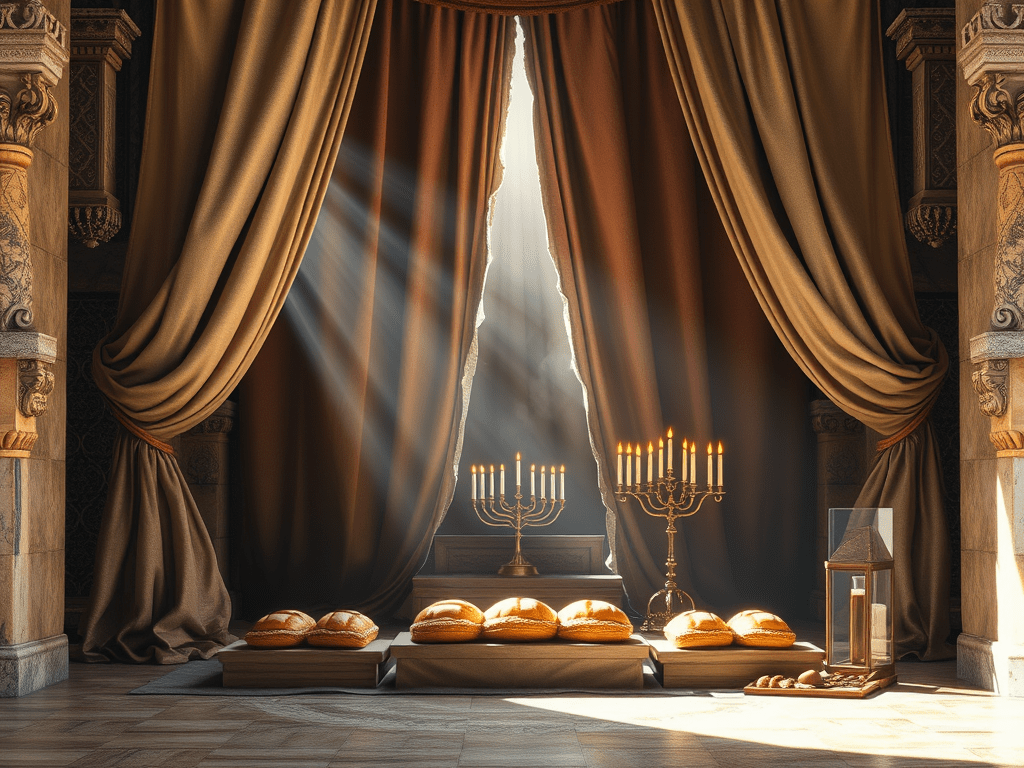
Now even the first covenant had regulations for worship and an earthly place of holiness. For a tent was prepared, the first section, in which were the lampstand and the table and the bread of the Presence. It is called the Holy Place. Behind the second curtain was a second section called the Most Holy Place, having the golden altar of incense and the ark of the covenant covered on all sides with gold, in which was a golden urn holding the manna, and Aaron’s staff that budded, and the tablets of the covenant. Above it were the cherubim of glory overshadowing the mercy seat. Of these things we cannot now speak in detail. These preparations having thus been made, the priests go regularly into the first section, performing their ritual duties, but into the second only the high priest goes, and he but once a year, and not without taking blood, which he offers for himself and for the unintentional sins of the people. By this the Holy Spirit indicates that the way into the holy places is not yet opened as long as the first section is still standing (which is symbolic for the present age). According to this arrangement, gifts and sacrifices are offered that cannot perfect the conscience of the worshiper, but deal only with food and drink and various washings, regulations for the body imposed until the time of reformation.
The Tension
As we begin this morning I want to skip down to the second half of verse 5 where we read, “Of these things we cannot now speak in detail.” We should first establish, as I have hinted in the introduction, that all the details about the tabernacle, that is the bread, the lampstands, the incense, the golden alters and urn, are not the main point. I know that may seem obvious but he tells us that, I think, to remind us not to get distracted in the details of the first covenant. We can and we should look at these things and see the substance they are imaging but to trifle with the details of those elements or to set up a menorah in your house or to try to burn incense in this same way or to always have 12 fresh loaves ready to eat are not the details which we focus on. Except maybe the bread, having 12 loaves ready at all times may not be a bad idea.
That being said I will point out of few things. In the lampstand, which was refreshed with oil daily so that the light never burned out, we find the image of Christ who is the light of the world. Of course Christ himself says in John 8 that he is the light of the world but we see this reality given to us fully and finally in Revelation.
Revelation 21:22–23ESV
And I saw no temple in the city, for its temple is the Lord God the Almighty and the Lamb. And the city has no need of sun or moon to shine on it, for the glory of God gives it light, and its lamp is the Lamb.
So the lampstand, images to us, the lamb of God, the light of the world whose light will never dim and never go out. We also see things like the bread, 12 loaves for the 12 tribes (the fullness of Israel, God’s people) and in that we see the fellowship with God and the provision of God for us, namely pointing to the bread of life. Perhaps not coincidentally after Jesus feeds the five-thousand, how many baskets of leftover bread is gathered? 12 baskets of bread are leftover and then a little later Jesus says,
John 6:32–35ESV
Jesus then said to them, “Truly, truly, I say to you, it was not Moses who gave you the bread from heaven, but my Father gives you the true bread from heaven. For the bread of God is he who comes down from heaven and gives life to the world.” They said to him, “Sir, give us this bread always.” Jesus said to them, “I am the bread of life; whoever comes to me shall not hunger, and whoever believes in me shall never thirst.
Also, the incense which was an image of the prayers of the saints continuously being lifted up to heaven also finds it’s fulfillment in Christ who is even now in the presence of the Father and who is sustaining us through his constant intersession on our behalf. The incense of Christ’s intercessory prayers for us is never burnt out. Again, we need to be careful not to get too caught up in those sacramental details but only insofar as they point us to the fulfillment in Christ.
We do need to get to the tension that is described in the text as we look further into how this illustration points us to Christ. The tension, that is shown to us through the sections of the temple is that though God calls his people to fellowship with him, his holiness always keeps up away. Murray says this:
Hebrews: Into the Most Holy Place
The veil was the symbol of separation between a holy God and sinful man: they cannot dwell together. The tabernacle thus expressed the union of two apparently conflicting truths. God called man to come and worship and serve Him, and yet he might not come too near: the veil kept him at a distance.… Love calls the sinner near; righteousness keeps him back. The Holy One bids Israel build Him a house in which He will dwell, but forbids them entering His presence there.
That tension and separation that the old system of the tabernacle images for us is a necessary tension for our understanding of both the nature of God and our status before him. When we gloss over that tension or paper over this illustration we miss the fundamental aspect of the gospel. God calls you to him but because he is holy, his presence is unattainable for you. This is extremely important to the illustration of the gospel, right? If you had access to God without Christ, if you could enter into the presence of God without Christ, if you think, like many others do, that heaven is available through many various paths then why did Christ have to suffer and die?
If there was some other way that a sinner may enter into the holy of holies apart from being cleansed through the blood of a sacrifice, then why was the blood of the Son of God spilt? Do you see the tension that the tabernacle creates in our minds? We don’t have access to God apart from Christ. There is a barrier between us and that barrier is also a grace because any who tries to enter into the presence of a holy God without the covering of blood will not survive. God is too holy for anything unclean to enter into his presence.
So often we try to break that tension by reducing God’s holiness and making him more like us or by attempting to cover or hide our shame. We sew some fig leaves together to meet him in hopes that such things cover our guilt but it doesn’t, it won’t, it can’t. The good news is that this tension is broken, this barrier is brought down, the curtain is torn, access to the presence of God is available but it is only available to those who are covered by the blood of the spotless lamb. The covering that God himself provides. The sacrifice of God’s son, Jesus Christ, for you has broken the tension that is so clearly imaged to us in the old covenant tabernacle.
Tragically what do you think happened when the Jewish priests discovered that veil was torn? I did a little research and best I can tell from the earliest first century writings, when they found it torn, they sewed it up again. Illustrating what we know to be true and what Hebrews is continually warning us against, they preferred the old to the new. They worshipped in the shadow when the true light was already shining.
The Spirit’s Shift
Now we begin to see the shift in the grand illustration by way of the revelation of the holy spirit. The illustration of the tabernacle has shown us so clearly that access to God is closed off to us on account of his holiness. What does the holy spirit, according to the text further communicate? “By this the Holy Spirit indicates that the way into the holy places is not yet opened as long as the first section is still standing.” As long as the old covenant and the old system of intercession is still standing, the access to God is not yet opened. As long as the levitical priestly system is in operation, the way to the holy places is barred.
But again, we aren’t really talking about the process itself are we? No, because what is the process showing us? That the righteousness of God requires a penalty for sin and a payment of blood for that sin. The way is barred until sin is atoned for by the shedding of blood. We know that the process itself wasn’t the point because could the blood of bulls and goats ever actually take away sins? Spoiler!
Hebrews 10:4ESV
For it is impossible for the blood of bulls and goats to take away sins.
So the Spirit indicates that as long as the first system and section is standing, our access into the presence of God is impossible. As long as we are depending on the illustration itself, we never get to the point of the story. As long as we rely of the blood of bulls and goats we won’t enter holiness or see the holy one. The key word in the text though is “yet”. The way into the holy places is not yet opened, emphasis on yet. The shift then, by way of implication, is that if the first section wasn’t standing, the way into the holy places would be opened.
If only there was a story given to us in the word where we see God requiring an impossible sacrifice but then in his grace, provided for himself the required sacrifice. “The Lord will himself provide us the lamb, my son.” Christ is that lamb, Christ is that sacrifice that fills in the illustration. Christ is the substance. Christ is the point of the story. Christ torn the veil and through which the spirit now indicates, the way to God is open. The holy places are no longer closed off, by the righteousness of Christ we can be brought to God.
1 Peter 3:18ESV
For Christ also suffered once for sins, the righteous for the unrighteous, that he might bring us to God, being put to death in the flesh but made alive in the spirit,
Perhaps even better is that this access to God is wholly unrestricted and unchanging. Because the sacrifice only needed to happen once and because that sacrifice was eternally sufficient our access to God and communion with God is forever secured.
Romans 8:14–16ESV
For all who are led by the Spirit of God are sons of God. For you did not receive the spirit of slavery to fall back into fear, but you have received the Spirit of adoption as sons, by whom we cry, “Abba! Father!” The Spirit himself bears witness with our spirit that we are children of God,
Just as the spirit had previously indicated that the way to God was closed, he now testifies and bears witness that our way to God, on account of Christ’s finished work is forever open and can never be barred or sewn up again. We do not fall back into fear but rather we continually enter into his presence, as adopted sons and daughters of the holy God.
The Clear Conscience
Hebrews 9:9–10ESV
(which is symbolic for the present age). According to this arrangement, gifts and sacrifices are offered that cannot perfect the conscience of the worshiper, but deal only with food and drink and various washings, regulations for the body imposed until the time of reformation.
The final point I want to make this morning is really a two-part point. The first of those is that this illustration teaches us that in the fulfillment of the old through the work of Christ there are no longer levels or degrees of God’s people. There are not people who confess Christ in faith but have yet to be actually saved because they have yet to achieve that higher level of sanctification. That would be people who are saved but aren’t really worthy to enter into the holiest of places. There can also never be someone who has fully arrived at Christianity in this life and no longer wars against sin. We are all in a continuous struggle against sin, to varying degrees, until we are made perfect by Christ alone in his presence for all eternity. This is what Paul says in Philippians when speaking about the struggle to attain the resurrection from the dead he says,
Philippians 3:12ESV
Not that I have already obtained this or am already perfect, but I press on to make it my own, because Christ Jesus has made me his own.
Because of Christ, and because of him making us his own, he has broken down these dividing lines of hostility that segmented us off from our access to God. In the clearing of our conscience he makes obsolete the distinctions and arrangements that not only divided us but offer to us no real freedom from our guilt. That is part two of this last point, that our consciences have been fully cleared. Not only are these distinctions absolved but our consciences are full cleared.
Let me wrap both of those up in yet another illustration. Many of you know this story but Martin Luther, in his younger life, battled mightily with the guilt of his sin and with the guilt of his conscience. Ultimately he went into the monastery as a way to escape his sin and free himself of the guilt. He was in essence sewing up the torn veil and attempting to hid his guilt on the other side. I couldn’t find the exact quote but I read a long time ago that he was quoted saying something like, “I went into the monastery to escape my sin only to find that the rascal followed me in there.” So it was there in the monastery that Luther confronted the real dark night of soul. The pain of guilt that his sacrifices were supposed to relieve remained and his conscience was more burdened than ever.
His conscience was finally cleared when the curtain and distinctions were torn down. Your conscience is cleared when you come to know that all those arrangements of food and drink, of washings and regulations, or anything else that you do to make yourself feel more holy don’t do anything to perfect the conscience because they were intended only to be illustrations revealing to us Christ who himself would be the one to fully and finally clear us of our guilt. It was Christ who gave up his body for us, it was Christ who entered into the holy of holies and was sacrificed for us, it was Christ who washed us clear of guilt and it was and it is Christ alone who clears our conscience.
You can sew up that curtain again and follow again the illustration instead of the point of the illustration and in doing so you will always maintain a cloud of guilt and a burdened conscience, or you can receive the substance by faith, that is Christ the Lord and be given freedom from the guilt of your sin.
John 8:36ESV
So if the Son sets you free, you will be free indeed.
Conclusion
Despite Thomas’s doubts and questions, our Lord gave us some great truth through the questions of Thomas. In John, it is recorded for us after Jesus told the disciples he was going ahead of them to prepare a place for them, Thomas said this,
John 14:5–6ESV
Thomas said to him, “Lord, we do not know where you are going. How can we know the way?” Jesus said to him, “I am the way, and the truth, and the life. No one comes to the Father except through me.
The reality of our status with God is so perfectly illustrated to us in the old covenant system of worship. The love of God calls us to worship him and to enter into his presence that we may dwell with him but his righteousness against our sin prohibited that access. So, we are left seeing our separation, filled with a conscience of guilt we are left saying, “Lord I desire to be close to you, I desire to enter into your holy presence, but I can’t, I am unclean and unworthy. I know somewhere deep down that I need to get to you Lord, but I don’t know the way.
Hear again the words of Christ, “I am the way and the truth and the life. No one comes to the Father except through me.” May our God open our hearts again to this truth and when he does may the words of Paul to the Corinthians be all the more true to us, the former isolated and lost sinners that we were.
1 Corinthians 6:11ESV
And such were some of you. But you were washed, you were sanctified, you were justified in the name of the Lord Jesus Christ and by the Spirit of our God.
And from that freedom and from that clear conscience, having entered into his holy presence, may you freely and joyfully serve the Lord of this grand illustration. Amen.





 The Wicket Gate
Leave a comment