
Introduction
Good morning! Turn with me to Hebrews, chapter 2. We are going to just be covering 4 verses this morning starting in verse 10 through verse 13. I am going to begin this morning by asking a somewhat ambiguous, trick question. You don’t have to answer out loud, What is one word you would use to describe your view of Jesus Christ? Maybe you thought mighty, or savior, God, or Lord. Maybe you thought servant or humble. I am willing to bet that no one thought of the word balanced as an answer to the question what is your view of Jesus.
The writer of Hebrews, and really the whole of the New Testament is giving us a balanced view of Jesus. I will explain what I mean. Hebrews began by showing Christ to us in a very high view, right? The supreme creator of all things, better than all the prophets, all the kings, and all the angels. This is a high view of Christ as Lord, King, Master, and Creator. Elsewhere though we see Christ as a poor carpenter, humble servant, a man of sorrows, or one in total submission to the fathers will. We have on one hand Jesus Christ as God, elevated far above the heavens, sitting on his throne and on the other a lamb led to the slaughter, mocked and ridiculed. Jesus, both commanding angels and washing feet.
This balanced view is very important to us because in the duality of his natures Christ really is all of those things. He is low and humbled and at the same time high and exalted. Often we have joked a little about the “Jesus is my homeboy” attitude that is often prevalent in our culture saying how foolish such an attitude is because Jesus is not our homeboy he is our Lord, our God and our King. To that I say Amen. However, and this is an important however, the writer of Hebrews is giving us a balanced view this morning by showing us that Jesus, along with being our Lord, is also our oldest brother.
Jesus is our King, he is our God, but he is also our brother and our friend. To anyone who scoffs at such an idea, our reply should be, then how can he be both the just and the justifier. If Jesus can’t be both your Lord and your brother, how can he be both master and servant? How could he be both God and man? If we take him as our savior we also have to take him as our Lord and if we take him as our God we also get the unspeakable privilege of taking him as our brother and friend. It is this balanced view of Jesus that ignites our hearts in love and devotion to him. When we see him as the author of Hebrews presents him another paradox is created. Jesus seems too good to be true and yet the truest thing we have ever known.
So we have seen him as the high and exalted God of the universe, this morning we will see him as our suffering sanctifier, our loyal brother who is not ashamed of us. Please stand with me once more as we read Hebrews 2: 10-13
10 For it was fitting that he, for whom and by whom all things exist, in bringing many sons to glory, should make the founder of their salvation perfect through suffering. 11 For he who sanctifies and those who are sanctified all have one source. That is why he is not ashamed to call them brothers, 12 saying, “I will tell of your name to my brothers; in the midst of the congregation I will sing your praise.” 13 And again, “I will put my trust in him.” And again, “Behold, I and the children God has given me.”
Jesus, Our Brother
We aren’t going to strictly follow the order of the text this morning, but instead we are going to firmly establish our relationship with Christ as brother, our relationship with God as a family and then we will consider sanctification in suffering. To begin then, we see in verse 12 of our text, we have another quotation from the Psalms. This time the author of Hebrews quotes Psalm 22. Turn back with me to Psalm 22 so you can see the context once again. Look first as verse 1 of Psalm 22, “My God, my God, why have you forsaken me.” Familiar words and a familiar verse, right? We have talked about this before but when Christ quoted Psalm 22 on the cross he was not claiming that Father had forsaken him but rather pointing us to Psalm 22 and himself as the true fulfillment of David’s words. Christ, through the inspiration of the spirit, gave David those words to begin with so on the cross Christ puts those words in his mouth to demonstrate that Psalm 22 is not just about crying out to God in suffering generally but more specifically about his suffering for a purpose. What purpose would that be? Psalm 22 ends with, “they (meaning God’s elect) shall come and proclaim his righteousness to a people yet unborn that he has done it.”
I hope that message is received loud and clear this morning above all messages, that he has done it. Because of his suffering at the hands of wicked men and his suffering under the wrath of a holy God we can not only proclaim his righteousness but we can receive his righteousness. Praise be to God, he has done it.
For our purposes this morning though, the writer of Hebrews takes verse 22 and attributes those words to Christ as well. Why wouldn’t he, they are the words of Christ right? One commentator noted that this is a reminder to us that Jesus is the true singer of the Psalms.
“I will tell of your name to my brothers; in the midst of the congregation I will sing your praise.”
Our Lord, the Lord, is calling us his siblings. As a result of his mercy and through his suffering he calls me his brother. If you are in Christ he calls you his brother or his sister. This is almost too much but we are just getting started.
15 For you did not receive the spirit of slavery to fall back into fear, but you have received the Spirit of adoption as sons, by whom we cry, “Abba! Father!” 16 The Spirit himself bears witness with our spirit that we are children of God, 17 and if children, then heirs—heirs of God and fellow heirs with Christ, provided we suffer with him in order that we may also be glorified with him. Romans 8: 15-17
In love 5 he predestined us for adoption to himself as sons through Jesus Christ, according to the purpose of his will, 6 to the praise of his glorious grace, with which he has blessed us in the Beloved. Ephesians 1: 5
Hugh Martin, 19th century Scottish minister says this,
“We find sonship in him: for he is the Son. The adopted sons have this privilege in the eternal Son. To bring saved men into a filial relation to God required a Saviour standing in that relationship himself. Hence when the fullness of the time was come, God sent forth his Son that we might obtain the adoption of sons.” We are adopted in Christ, and he then remakes our spiritual dna by pouring the Holy Spirit into our hearts to make us real members of the family.
So to say that Christ is our brother is far more than just a trite saying or something to comfort us when we are feeling rejected. It certainly is a comfort, but it is a comfort because it’s true. You were alienated and estranged, spiritually orphaned. You were homeless and wandering without a family but God saw you in that state and called you from it and adopted you into the royal family of God and as a result you are the true and everlasting brother/sister of Christ.
Even more, he is not ashamed to call us his brother or sister. How many of us have lived under the weight of trying not to bring shame upon our family? How many have brought shame, justified or unjustified and had to live in the pain of hostility or regret? If you have experienced any of that you can relate to how tremendous it is to know that Christ knew all your shame before even you did and yet he still suffered the cross for you. He bore the burden and drank the cup so that he might call you brother, and he is not ashamed that you are in his family.
14 For he himself is our peace, who has made us both one and has broken down in his flesh the dividing wall of hostility 15 by abolishing the law of commandments expressed in ordinances, that he might create in himself one new man in place of the two, so making peace, 16 and might reconcile us both to God in one body through the cross, thereby killing the hostility. Ephesians 2: 14-16
That is more practically why/how Jesus is the answer to all the problems that we began to discuss last week. Through faith in Christ we have been brought into a new family. We have died to who we once were and were reborn as new people, with new names and new identities. We are children of God and in him and through him there is no more hostility. In Christ, we are reconciled to God. Christ himself is our peace and we have that peace in him, free from shame. This is also why “family” now for the believer means something different.
The Family of God
Family doesn’t primarily mean for us those of blood relation or maybe it’s better to say that it means more for us than just that. .
29 For those whom he foreknew he also predestined to be conformed to the image of his Son, in order that he might be the firstborn among many brothers. Romans 8: 29
I know I am repeating myself a bit here but I want you to get it. Christ was the first born of a new creation that is presently being remade by him. He is also the first born of a new family that are all being adopted under his name.
“Truly, truly, I say to you, unless one is born again he cannot see the kingdom of God.” 4 Nicodemus said to him, “How can a man be born when he is old? Can he enter a second time into his mother’s womb and be born?” 5 Jesus answered, “Truly, truly, I say to you, unless one is born of water and the Spirit, he cannot enter the kingdom of God. 6 That which is born of the flesh is flesh, and that which is born of the Spirit is spirit. 7 Do not marvel that I said to you, ‘You must be born again.’ John 3: 3-7
Everyone had a first birth and according to Christ the fact that you were born once doesn’t do anything for you spiritually. You must die to your flesh and be born again in the spirit by faith. This second spiritual birth brings us into a new family. Look around the room. Seriously, look around the room. This is your family. These are you brothers and sisters whom you will spend eternity with. Christ is our older brother who not only gives us the perfect model of what a sibling looks like but his work started this amazing family that we have the privilege of being a member of.
11 For he who sanctifies and those who are sanctified all have one source.
The one who sanctifies, Jesus Christ, and those who are being sanctified, us, all have one source. We are all united in the same family, the royal family of God. That is why he has no shame in calling us his brothers and sisters because we all have our spiritual origin and unity in him, in the Godhead. Let me be clear here that this does not mean that we are all somehow mushed together in this bland, Unitarian family. We are not Unitarians. God is one but he is also three distinct persons and without slipping into heresy we can consider the body of Christ in somewhat the same way. One in Christ but also still uniquely distinct.
We have to be ok with these paradoxes and keep a balanced view. We are individuals and at the same time all one. Distinct branches of the same tree to use a biblical metaphor. This is important to emphasize because when we get real about the true nature of our family and our adoption into this family we begin to see what our intended purpose is in life. We glorify God when we are recognized as holy people of God.
21 assuming that you have heard about him and were taught in him, as the truth is in Jesus, 22 to put off your old self, which belongs to your former manner of life and is corrupt through deceitful desires, 23 and to be renewed in the spirit of your minds, 24 and to put on the new self, created after the likeness of God in true righteousness and holiness. Ephesians 4: 21-24
Fundamental to this new identity and new family is to put off the old self and put on the new. To be conformed after the likeness of God in true righteousness and holiness. The chief end of man is to glorify God and enjoy him forever. Amen. A part of that end is the sanctification that happens in this life, more specifically transformation into holiness. Richard Phillips says this,
Francis Schaeffer once defined the basic aspiration of people today, including evangelical Christians, as material affluence and enough personal peace to enjoy it. But what we see in this passage is something far greater, a higher and more wonderful destiny and calling. We were reborn in Christ as his fellow brothers and sisters for the glory that is his in the heavenly realms, and the holiness that distinguishes God and his children. This is what the Christian life is about—growth in holiness. This involves the progressive removal of the old man, leaving sin behind us, while we are putting on the new man. We call this process sanctification, and it is our calling and our destiny and our duty.
Perfect Through Suffering
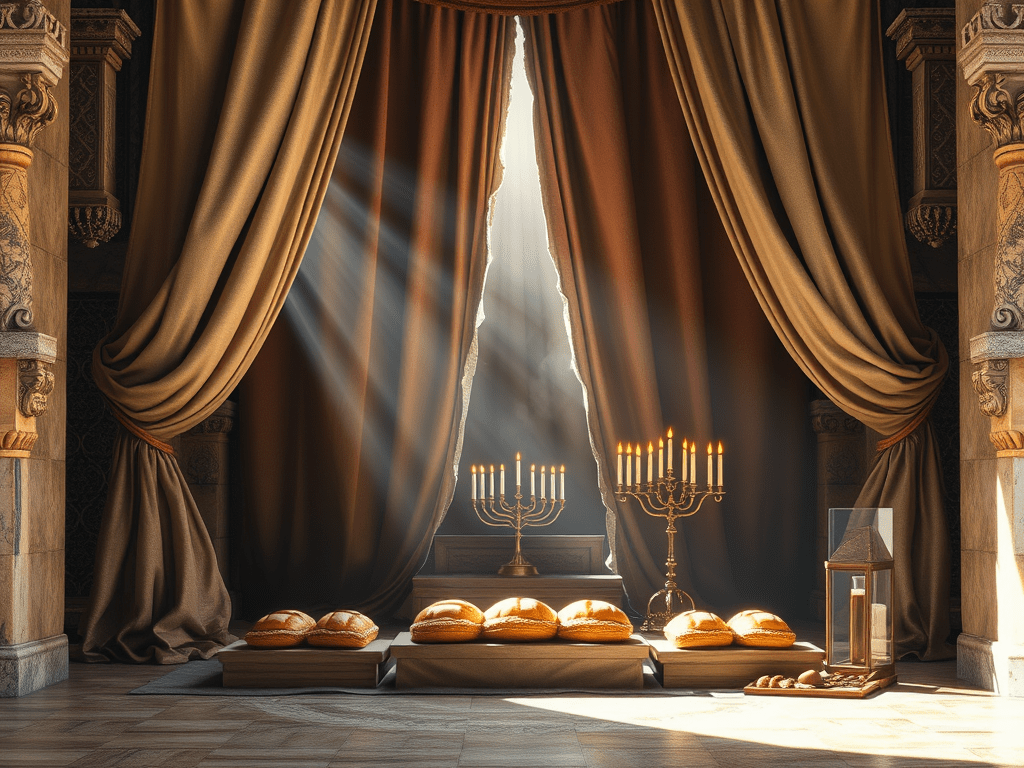
Remember back in Genesis when we considered the fall of man we noted that when God sent Adam and Eve out of the garden he stationed cherubim to guard the entrance of the garden. Later when God gave instructions for the sewing of the curtain that veiled the entrance into the holy of holies, he instructed them to embroider cherubim there as well right? There was this constant reminder to them of their separation from God and from his holiness and that the separation was the result of their sin.
The law too should have been a constant reminder that the standards of holiness that were required were so far beyond our reach that our state was utterly hopeless. It was in this state of hopelessness that Christ entered into.
23 for all have sinned and fall short of the glory of God, 24 and are justified by his grace as a gift, through the redemption that is in Christ Jesus, 25 whom God put forward as a propitiation by his blood, to be received by faith. This was to show God’s righteousness, because in his divine forbearance he had passed over former sins. 26 It was to show his righteousness at the present time, so that he might be just and the justifier of the one who has faith in Jesus. Romans 3: 23-26
When our text says that Christ was made perfect through suffering it was not that Christ needed to be perfected but rather that he was consecrated through his suffering that he might be the holiness that was required of us but that we could not attain. This consecration required the shedding of blood and it required suffering and Christ perfected us through his suffering.
He spilled his blood and he himself was the mercy seat on which that blood was spilt. He satisfied the requirement for entrance back into paradise, he relieved the cherubim of their duty. He tore the curtain which separated us from God and gave us once again unfettered access to the holiness of God.
11 But when Christ appeared as a high priest of the good things that have come, then through the greater and more perfect tent (not made with hands, that is, not of this creation) 12 he entered once for all into the holy places, not by means of the blood of goats and calves but by means of his own blood, thus securing an eternal redemption. 13 For if the blood of goats and bulls, and the sprinkling of defiled persons with the ashes of a heifer, sanctify for the purification of the flesh, 14 how much more will the blood of Christ, who through the eternal Spirit offered himself without blemish to God, purify our conscience from dead works to serve the living God. Hebrews 9: 11-14
So the purpose of Christ’s life was the securing of an eternal redemption and it was efficacious because Christ was a worthy and holy and perfect sacrifice. Now for us having received that redemption by grace through faith the purpose of our lives is to draw near to and be transformed by the holiness of the one who saved us.
19 Therefore, brothers, since we have confidence to enter the holy places by the blood of Jesus, 20 by the new and living way that he opened for us through the curtain, that is, through his flesh, 21 and since we have a great priest over the house of God, 22 let us draw near with a true heart in full assurance of faith, with our hearts sprinkled clean from an evil conscience and our bodies washed with pure water. Hebrews 10: 19-22
Conclusion
A few points of application as we close this morning. First, this text shows us the true nature of love, and of the vastness of God’s love for us. John Murray says this,
What love for men that the Father should execute upon his own Son the full toll of holy wrath, so that we should never taste it! This was John’s amazement when he wrote: ‘This is love, not that we loved God, but that he loved us, and sent his Son to be the propitiation for our sins’
The suffering that Christ endured on the cross for our salvation and sanctification must be seen as the grandest act of love. What is love? Not what we do that we call love, that’s not love. What is love is that Christ came in flesh to suffer the full wrath of God so that he could give us his righteousness that we may call him our brother. That is love.
Secondly, because Jesus is not ashamed of us we should not be ashamed of him. If it was fitting for God to humble himself to save a sinner such as I, then it should be equally fitting for me and you to unashamedly sing praises to and serve our great savior.
8 Therefore do not be ashamed of the testimony about our Lord, nor of me his prisoner, but share in suffering for the gospel by the power of God, 9 who saved us and called us to a holy calling, not because of our works but because of his own purpose and grace, which he gave us in Christ Jesus before the ages began, 2 Timothy 2: 8-9
Finally, as 2 Timothy alludes, the text calls us to be unashamed to bear scorn, to suffer for his sake, or to be sanctified into the holiness that he paid such a price to give us. This is really a tough one because standing with Christ, and standing up for him, our dear brother and Lord will always put us in tough situations. He was unashamed of us and that sent him to the cross. Fortunately for us being unashamed of Christ will almost certainly not send us to a cross, thanks be to God but it will put you in difficult conversations with co-workers and friends. It will often call on you to deny yourself and your desires, to say no when you want to say yes and yes when you want to say no.
Maybe it means you can’t laugh along with all your co-workers’ jokes or act like one of the guys. Maybe it means you tell someone not to gossip instead of joining in. There are a million ways this plays out in our lives but the point is not to put legalism on you but to encourage you in your pursuit of holiness. Through his suffering Christ is sanctifying, perfecting you. If you are in Christ you have been adopted into a royal, and holy family.
The last verse that our text referenced this morning was from Isaiah 8. This verse speaks of trusting in the testimony of God despite worldly pressures and waiting on the Lord.
17 I will wait for the Lord, who is hiding his face from the house of Jacob, and I will hope in him. 18 Behold, I and the children whom the Lord has given me are signs and portents in Israel from the Lord of hosts, who dwells on Mount Zion. 19 And when they say to you, “Inquire of the mediums and the necromancers who chirp and mutter,” should not a people inquire of their God? Should they inquire of the dead on behalf of the living? 20 To the teaching and to the testimony! If they will not speak according to this word, it is because they have no dawn. 21 They will pass through the land, greatly distressed and hungry. And when they are hungry, they will be enraged and will speak contemptuously against their king and their God, and turn their faces upward. 22 And they will look to the earth, but behold, distress and darkness, the gloom of anguish. And they will be thrust into thick darkness.
But there will be no gloom for her who was in anguish. The people who walked in darkness have seen a great light; those who dwelt in a land of deep darkness, on them has light shone. 3 You have multiplied the nation; you have increased its joy; they rejoice before you as with joy at the harvest, as they are glad when they divide the spoil.
How can we be assured of this and live unashamed of him? Just a few verses later in Isaiah.
6 For to us a child is born, to us a son is given; and the government shall be upon his shoulder, and his name shall be called Wonderful Counselor, Mighty God, Everlasting Father, Prince of Peace.
Christ is our brother, Christ is our Lord, Christ is the first born of our new family. He is our counselor, our God, and our peace. This is the balanced view we must have of the one who unashamedly suffered for our sanctification. Amen.
Bibliography
Phillips, Richard D. 2006. Hebrews. Edited by Richard D. Phillips, Philip Graham Ryken, and Daniel M. Doriani. Reformed Expository Commentary. Phillipsburg, NJ: P&R Publishing.
The Holy Bible: English Standard Version (Wheaton, IL: Crossway Bibles, 2016)





 The Wicket Gate
Leave a comment