Introduction
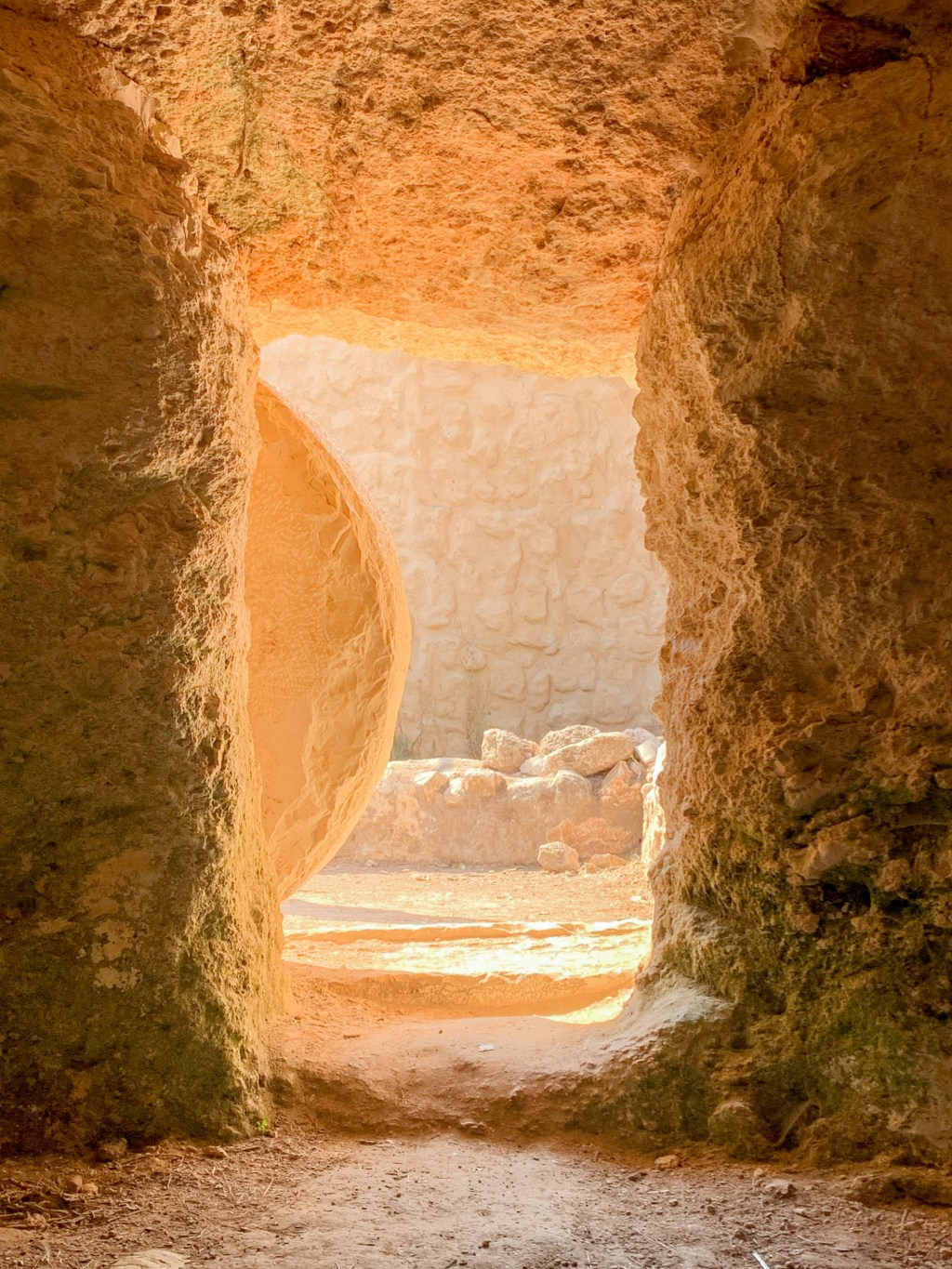
Let me say to begin, our Lord is risen! The past two Easter Sunday’s we have looked at texts outside of the resurrection narrative and focused more on gospel centered passages. There will certainly be plenty of Gospel this morning but I want to look specifically at the story of the resurrection as given to us in the gospels, continuing with the previous weeks which have walked through that resurrection narrative. The overarching theme, which is also the title of this sermon, is “The stone is rolled away.” I want to look at this passage with fresh eyes and perhaps give you a different perspective as we consider that the stone has been rolled away.
Yes, as I often try to do, I am likely going to wreck your childhood memories and Easter coloring pages from Sunday school. No surprise but they were half truths and the real story is perhaps way better. That’s all I am going to give you as an introduction so turn to the gospel of Matthew, chapter 28, we will read verse 1 through 10.
28 Now after the Sabbath, toward the dawn of the first day of the week, Mary Magdalene and the other Mary went to see the tomb. 2 And behold, there was a great earthquake, for an angel of the Lord descended from heaven and came and rolled back the stone and sat on it. 3 His appearance was like lightning, and his clothing white as snow. 4 And for fear of him the guards trembled and became like dead men. 5 But the angel said to the women, “Do not be afraid, for I know that you seek Jesus who was crucified. 6 He is not here, for he has risen, as he said. Come, see the place where he lay. 7 Then go quickly and tell his disciples that he has risen from the dead, and behold, he is going before you to Galilee; there you will see him. See, I have told you.” 8 So they departed quickly from the tomb with fear and great joy, and ran to tell his disciples. 9 And behold, Jesus met them and said, “Greetings!” And they came up and took hold of his feet and worshiped him. 10 Then Jesus said to them, “Do not be afraid; go and tell my brothers to go to Galilee, and there they will see me.”
Matthew 28: 1-10 – ESV
The Significance of the Stone
As we begin, I want us all to think back to your time as a child in Sunday school. For those who grew up in church, you undoubtedly did a coloring page or craft that involved Jesus emerging triumphantly from the tomb with the stone rolled away behind him. Several film adaptations of the resurrection show an angel coming down from heaven and rolling the stone away and a bright light coming from inside the tomb as the resurrected Jesus emerges from the tomb. These are all very dramatic portrayals of this event but the question I want us to consider is, “Is that really how it happened?” If not, how did it happen and what difference does that make. You all know that our responsibility and certainly my responsibility is not only to make sure you think rightly about the bible, so far as I am able, but that you also know why that matters. I do earnestly pray that our God would show you this morning not only the infinite grace that he provides for us in the resurrection but also the same grace that is displayed in the reality that the stone is rolled away.
In this effort I want us to consider another passage a little later in the resurrection story. This story is recorded in several of the other gospels but for our purposes this morning turn to the gospel of John, Chapter 20, verse 19.
19 On the evening of that day, the first day of the week, the doors being locked where the disciples were for fear of the Jews, Jesus came and stood among them and said to them, “Peace be with you.” 20 When he had said this, he showed them his hands and his side. Then the disciples were glad when they saw the Lord.
John 20: 19-20 – ESV
What sticks out to you about that story? The disciples, fearing that at any moment the Jewish authorities were going to find them and do to them what they did to Jesus they essentially locked and barricaded themselves in a room. Somehow though, Jesus still managed to get into the room with them. We have to read between the lines a little but it seems obvious that he didn’t come through the door. The account of this story that we get in Luke tells us that they thought he was a ghost or a spirit because he either appeared out of nowhere or perhaps he just moved through the wall but again, he didn’t use the front door.
We know further that it was the actual flesh, blood and bones of the resurrected Jesus because he showed them his hands and his side and they touched flesh and bones. So how does flesh and bones walk through walls? How did the resurrected body of Jesus enter a locked room? I am not here to speculate on the how except to say that he did it. I will further have nothing to do with the materialistic argument that supposes that there has to be something missing from the text or that there is some other logical explanation. We are talking about a man who, after hanging on a cross for hours bleeding to death, had a spear run through his side and was pronounced dead by Roman executioners who knew pretty well what they were doing. This same man lay dead in a tomb for around 48 hours and then on Sunday morning woke himself up, all his wounds having been completely healed but yet we get hung up on the fact that maybe he can also walk through walls.
Do not be ashamed to think, nor let a materialistic world call you crazy because you believe that a stone tomb, however thick, or a locked door, however strong, is wholly insufficient to keep our Lord from showing up when he says he will. So as we bring that truth into Easter we have to consider the stone being rolled away. Why was the stone rolled away? Surely you don’t think, like perhaps your mind was guided as a child, that the stone was rolled away so that Christ could get out of the tomb. Do we consider our Savior and our King as one who will let a stone, even an immensely heavy one, stand in his way? Or that he needed an angel to come break him out? Of course not!
Unashamedly my favorite passage in all of scripture.
38 For I am sure that neither death nor life, nor angels nor rulers, nor things present nor things to come, nor powers, 39 nor height nor depth, nor anything else in all creation, will be able to separate us from the love of God in Christ Jesus our Lord.
Romans 8: 38-39 – ESV
Let me clarify “anything else in all creation” if I may. Locked doors, large stones, stubborn wills, disobedient hearts, doubts and fears, even 3-fold denials. When our Lord has set his affection upon you nothing will stop him from redeeming and taking for himself what is his. If you are in Christ, he has rescued you and for at least some of you, he had to walk through a locked door to get to you.
We will get to what I think the rolled away stone means in just a second but I want to make sure that you see in the narrative in Matthew that it appears that our Lord was out of the tomb before the stone was rolled away. There are some differences in the gospels about who all was there initially when the stone was found to be rolled away but I think exactly who was there is a secondary issue. These women were making their way down to the tomb, as our text says, and at some point during that walk there was an earthquake, an angel of the Lord descended from heaven, rolled the stone away and sat on it. Presumably waiting on the women to get there so he could tell them what was going on. That is exactly what happened right?
We read it, I can read it again if you want but it reads plain enough to me. If we were to look at this account from the other gospels we will find it viewed from different perspectives and some of the details rearranged but all support the same idea. This also lends itself to the reality that the spirit’s inspiration of our Scripture left room for human agency. Some of the details are left to the perspective of the writer but the main focus is always clear, by the time the stone was rolled away, our Lord was already gone. You may be really wondering by now why that matters. Isn’t this a trivial detail to quibble about? I’m spending, perhaps the best Sunday sermon of the year, splitting a hair. Why does it matter if Jesus came out through the front door or by some other supernatural means? This is why I think it matters.
If the stone was rolled away so that Jesus could exit the tomb then the rolling of the stone was by necessity. If the stone was rolled away after he was already out then the rolling of the stone becomes a divine act of Grace. That is what we see in our text right? In perhaps the most underrated line in scripture we see the angel tell the women, “Come and see the place where he lay.” The stone was rolled away, not so that Jesus could have some grand entrance back into the land of the living but so that we could enter in and see that our King is not dead. Our Lord with a flick of his pinky finger could have turned that stone to dust but that isn’t how he operates right? At least not yet.
Put yourself in the position of John who we know was an eyewitness to the crucifixion. He was there and saw what Christ went through. He saw the nails driven through his hands and the spear ran through his side. He saw Christ die, and possibly saw the deceased body of our Lord up close. John, when he heard the news of Christ sprinted to the tomb, out running Peter to get there, entered through the passage left by the stone having been rolled away and John records that he went in, he saw, and he believed. “For as yet they did not understand the Scripture, that he must rise from the dead.”
In this singular moment of clarity everything likely came crashing down on John and he connected all that he knew about the Old Testament and all the teachings of Jesus. In that moment, his eyes were fully opened to the truth and he believed. Not belief as it had been before because he would have confessed before the resurrection that he believed but he now believes as one who has had the true revelation poured into their hearts. “Oh my Lord, How could I have been so blind as to not see this?” I imagine him thinking. “He is real.” “He is the the Christ”
This is the same John who wrote in his gospel, “but these are written so that you may believe that Jesus is that Christ, the Son of God, and that by believing you may have life in his name”. Not belief as John had while he walked with Jesus and followed most of his teaching, many have that belief. Rather belief that heeds the words of the angel at the tomb, “come, see the place where he lay.”
Not the belief that Peter had who while Christ was still alive confessed Jesus to be the Christ and said he would fight to the death for him but then later denied him three times. But the belief after Peter saw the empty tomb and stood before the same people who shouted “crucify him” and through the empowerment of the spirit declared, “Let all the house of Israel therefore know for certain that God has made him both Lord and Christ, this Jesus whom you crucified.” How can he be so certain? Only because of the grace of God. Only because our God did not leave him wondering. Did not keep the tomb sealed. Did not reveal himself before first having shown him that the tomb was empty.
What grace is this that our Lord would not only do all that he did for us and that we talked about over the past few weeks, but that he would also leave no room for doubt. Do you know this to be true? Even Thomas, who doubted and said, “No, I need to see him for myself, Christ showed up.” He has made it so plain, and so clear and by his grace he does not ask us to leap blindly in the dark or trust in something that can’t be proven. It has been proven. He rolled the stone away to say to all of us, “come in and see the place where I lay.” He is not there because our King is alive. Does it all make sense to you this morning? Have you like John, though hesitant at first, walked into the tomb to see where he lay and by the grace of God had all those pieces put together?
This is precisely what we do every year. Enter once again into the tomb so that we may be reminded, yes, it really was empty. To be reminded that though Christs’ was the first tomb to be emptied it most certainly won’t be the last. If by his grace, you believe this morning, believe that Jesus was and is the Christ, the son of the living God. Believe that God wrapped himself in humanity to earn righteousness for us, because he certainly didn’t need to earn it for himself. Believe that he willingly went to the cross to appease the wrath of the Father that was pointed directly at your sin. Believe that he is now willingly giving the righteousness that he earned to his children free of charge, all by his good grace. Believe that he rolled the stone away to leave no doubt and to open your eyes to see that he is all these things and did all these things. [You might say that he left no stone unturned.] If by his grace you believe that this morning, there will be a day when an empty grave will be left behind where you once lay. I can’t promise that you will be able to walk through walls, but I can promise that for all eternity you will be with the one who did.
What Are We to Do?
That leads us to the second aim of the text and that is what are we to do with and in light of this knowledge. There are three things I want us to take away this morning. First, it is obvious, we must believe. I mentioned Thomas (as recorded in the gospel of John) and it was to him that Christ said, “Have you believed because you have seen me? Blessed are those who have not seen and yet have believed.” The next two verses following the words of Christ are those of John stating his purpose for writing the book, which we have discussed, that we may read these words and believe. So in one sense we believe not having the benefit of seeing the physically resurrected body of Christ but we have hardly been left in the dark on the matter. We have been given this testimony, true historic accounts of those who did see him, so that we may know beyond all doubt that Christ was and is everything that he claimed to be and that he accomplished everything that he said he would accomplish.
This is without dispute. This is verifiable and verified, eyewitnessed, documented, fact. All by his grace so that everyone is far beyond excuse. You will have nothing to say when you stand before you God on the final day because he has made it so plain to you. His grace has literally opened the door, we must believe.
This is not a surface belief though is it. It is not a pre-resurrection belief, it is a spirit given, divine grace, active, worship inducing kind of belief. This belief, for our purposes now we can call it faith, is not only a gift grounded in his grace which I hope I have labored to show but it also manifests itself in particular ways. We see it in Thomas, who upon the revelation of Christ responded, “My Lord and my God.” This is an act of worship. This is the second thing we are to do in response to the resurrection, we are to worship.
We see this as well in the main text we read this morning, Matthew 28. verse 9. “And behold, Jesus met them saying, Greetings! And they came up and took hold of his feet and worshiped him.” Side note that this is also a clear indication of the divinity of Christ because remember when Satan tempted Jesus, he responded by saying that we are to worship God alone. Here he allows these women to worship at his feet and does not stop them or correct them. He receives their worship which means, as Brother David said last week, Christ is either an egomaniac, a devil, or he is truly God. If he is truly God, which he is, the first and only proper response is worship.
Worship is much more than singing songs on Sunday morning and listening to a sermon once a week right? Worship is the constant and continued expression of adoration and devotion to our God and Savior. Worship is not a singular act or something that we do, worship is the disposition of our hearts now bent towards and straining to reach the one who has given himself for us. Worship is returning a life of sacrifice and obedience to the God who sacrificed himself for you. Worship to God takes on many forms for all of us but it is certainly no less than a life given in sacrificial devotion to the risen King.
Finally, as we see in verse 10 in response to the resurrection, we need to tell somebody. “Then Jesus said to them, Do not be afraid; go and tell my brothers to go to Galilee, and there they will see me.” Just a few versus later in Matthew, Jesus of course commissions the disciples to go on a much larger scale but the point is that the resurrection was not meant to be kept secret. Much of Jesus’s life he was trying to minimize the work that he was doing, trying to keep things quiet and under wraps to avoid a potential uprising. But that all changed when he announced “it is finished.” When Christ came out of the grave and ascended to the right hand of the father and claimed all authority on Heaven and Earth, no longer did he say don’t tell anyone about what I have done for you.
Now he says go and tell everyone, from every nation. And don’t just tell them, make them disciples, that is followers of me. Teach them and train them in obedience and righteousness. Teach them sound doctrine, show them the truth, being ready for every good work. If the word commands us to do that for others, it certainly means for us to be all those things as well.
Conclusion
In conclusion then, He is risen! How do we know this? How can we be sure? Because by the grace of God, the stone is rolled away. Not just that, he invites us in to come and see the place where he lay, it’s empty. Only some folded cloth remains at the spot where he lay. See and believe, church. Hear and believe. Our King is alive. The uprising has begun. Will we give our lives to him, will we serve him, will we fall at his feet and worship him, will we make disciples for him? May our God make it so in all of us. The final bit of good news is that though the tomb is empty and Christ has returned again to heaven, he has not left us to this life alone. Let me remind you again how the book of Matthew concludes. “And behold, I am with you always, to the end of the age.” He is risen, but he has not gone. If you would reach for him you will find that he is actually not far from each one of us. This too is such an amazing grace. Amen.





 The Wicket Gate
Leave a comment